India's Special Forces by P C Katoch Saikat Datta
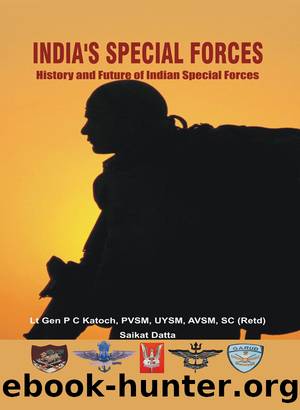
Author:P C Katoch, Saikat Datta [P C Katoch, Saikat Datta]
Language: eng
Format: epub
Tags: History, Military, Wars & Conflicts (Other), Special Forces, Technology & Engineering, Military Science
ISBN: 9789384464059
Google: eDoQrgEACAAJ
Publisher: Rohan Vij
Published: 2014-11-25T03:32:54+00:00
4
Still Birth Special Forces Regiment and Special Forces Training School
In 1979, President Jimmy Carterâs administration in the United States was presented with a major crisis. The Islamic revolution in Iran had stranded the employees in the American Embassy in Tehran and they were being held hostage. Negotiations had spun out of control and President Carter was desperate for a solution that could get the Embassy personnel back home safe.
After several rounds of deliberations President Carter agreed to an ambitious plan that had been put forward by the US Military. He was quickly briefed about a secretive military unit, known as the Delta Force, which was a part of the United States Army Special Forces and had been raised and trained for exactly the kind of a mission that had now come up.
The Delta Force was a popular name for Operation Detachment Delta, a new unit that was created after an American Special Forces officer returned after a stint with the British SAS. Major Charles Beckwith was so impressed at the vast range of skills and capabilities that the SAS had built up over the years, he felt that this was exactly the kind of unit that the American Armyâs Special Forces were looking for. Once the top military leaders were convinced about the need for such a unit, he started to raise a unit that would rival the SAS. He used the same structure, calling his teams âsquadronsâ just like the SAS described its company level sub units. Delta Force had not been deployed in any major operation and the planned mission in Iran would be its first.
Operation Eagle Claw proved to be a massive failure soon after it was launched. There were so many disparate elements and forces that no one really knew who was doing what. This led to a situation where the communication gear was not in sync and there were instances when the Special Forces men on the ground did not even share the same frequencies. With both sides âblindâ to each otherâs capabilities, Operation Eagle Claw became a spectacular disaster as a helicopter and a C-130 fixed wing aircraft crashed in the Iranian deserts. The failure led to a lot of soul searching within the American military and the Joint Chiefs of Staff commissioned a Special Operations Review Group headed by Admiral James L Holloway with five other members to look into the causes of the failure. The Review Group produced a comprehensive report that would explain why the mission had failed and recommend major reorganisational changes.
But while the military was looking at fixing the problem, the United States Congress and the Senate was looking at a larger resolution. Two Senators would work closely with the military and other experts and push through the Goldwater-Nichols Reorganisation of the Pentagon Act that would mandate comprehensive military reforms. However, it was felt that the Goldwater-Nichols Act had failed to address the Special Operations issues comprehensively. So two other Senators, Sam Nunn and William Cohen, one Republican and the other a Democrat, got together and studied the problem.
Download
This site does not store any files on its server. We only index and link to content provided by other sites. Please contact the content providers to delete copyright contents if any and email us, we'll remove relevant links or contents immediately.
| Africa | Americas |
| Arctic & Antarctica | Asia |
| Australia & Oceania | Europe |
| Middle East | Russia |
| United States | World |
| Ancient Civilizations | Military |
| Historical Study & Educational Resources |
The Radium Girls by Kate Moore(12110)
100 Deadly Skills by Clint Emerson(4983)
Rise and Kill First by Ronen Bergman(4853)
The Templars by Dan Jones(4748)
The Doomsday Machine by Daniel Ellsberg(4574)
The Rape of Nanking by Iris Chang(4274)
Killing England by Bill O'Reilly(4062)
Stalin by Stephen Kotkin(4021)
Hitler in Los Angeles by Steven J. Ross(3993)
12 Strong by Doug Stanton(3589)
Hitler's Monsters by Eric Kurlander(3410)
The Code Book by Simon Singh(3267)
Blood and Sand by Alex Von Tunzelmann(3255)
Darkest Hour by Anthony McCarten(3183)
The Art of War Visualized by Jessica Hagy(3056)
Hitler's Flying Saucers: A Guide to German Flying Discs of the Second World War by Stevens Henry(2784)
Babylon's Ark by Lawrence Anthony(2742)
Tobruk by Peter Fitzsimons(2572)
The Second World Wars by Victor Davis Hanson(2558)
